
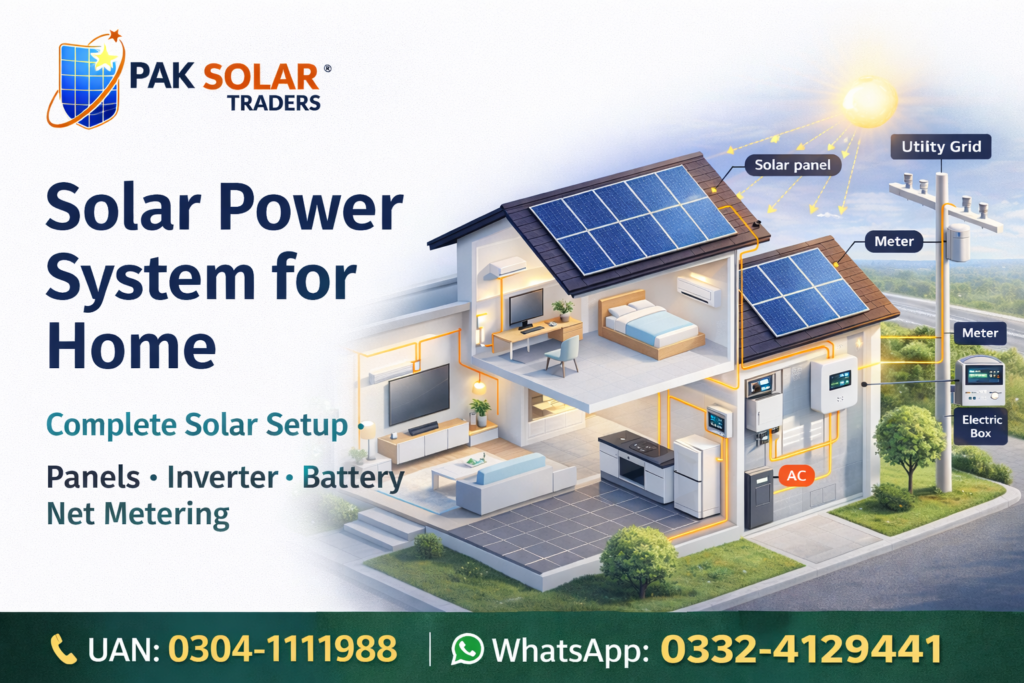
Pakistan’s electricity tariffs have crossed record highs in 2026, and grid load-shedding is still a daily reality in most cities. Solar power is no longer a luxury upgrade — it is the standard way homes, offices, factories, farmhouses and hospitals across Punjab are cutting bills by up to 90% and protecting themselves from outages. This page is your complete, up-to-date solar system price in Pakistan reference for 2026 — covering On-Grid, Hybrid and Off-Grid solar systems, lithium battery backup pricing, brand comparisons, net metering rules, and city-wise availability. We supply and install solar panels, inverters, lithium batteries, mounting structure, protection devices and complete commissioning — under one roof, with one warranty point of contact.
On this page
- On-Grid vs Hybrid vs Off-Grid
- Solar System Price in Pakistan 2026
- Hybrid Solar PV System with Lithium Battery
- What Affects the Price
- Panel, Inverter & Battery Brands We Supply
- Net Metering & Net Billing (NEPRA 2026)
- Availability Across Punjab
- How to Choose the Right Size
- Our Installation Process
- Why Pakistan Solar Traders
- FAQs
On-Grid, Hybrid & Off-Grid Solar Systems — Which One Is Right for You?
Choosing between an on-grid solar system, a hybrid solar system and an off-grid solar system is the single biggest decision that affects your solar system price in Pakistan. Each works differently with the WAPDA/DISCO grid and with battery storage:
| System Type | Battery Backup | Works During Load-Shedding? | Best For |
|---|---|---|---|
| On-Grid (Grid-Tie) | None | No — shuts down for safety | Lowest cost per kW, maximum net metering savings, daytime-heavy loads |
| Hybrid (with Lithium Battery) | Yes — Lithium (LiFePO4) | Yes — seamless UPS-style backup | Homes/offices needing backup + bill savings; Pakistan’s most popular residential choice in 2026 |
| Off-Grid | Yes — Lithium or Tubular | Yes — fully independent of WAPDA | Farmhouses, tubewells, remote sites with no or unreliable grid connection |
In 2026, hybrid systems carry roughly a 50–70% price premium over comparable on-grid setups because of the added lithium battery and hybrid inverter cost — but they have become the default residential choice in Pakistan because they keep critical loads (lights, fans, WiFi, fridge, and often AC) running through outages while still exporting surplus units under NEPRA’s net billing framework.
Solar System Price in Pakistan 2026 — Size-Wise Price Guide
Below is our 2026 market price guide covering the full range of solar system prices in Pakistan, from small home kits to industrial-scale plants. Ranges include panels, inverter, structure, DC/AC cabling, protection devices and standard installation. Final pricing depends on brand tier, site conditions and exact battery capacity — share your electricity bill on WhatsApp (0300-0644424) for a firm, itemized quote.
| System Size | On-Grid Price (PKR) | Hybrid + Lithium Price (PKR) | Typical Use |
|---|---|---|---|
| 1kW Solar System | 150,000 – 220,000 | N/A (too small for battery ROI) | Lights, fans, router, basic loads |
| 3kW Solar System | 350,000 – 580,000 | 500,000 – 650,000 | Small homes, 1 inverter AC |
| 5kW Solar System | 496,000 – 800,000 | 771,000 – 1,093,000 | Medium homes, 5-marla to 10-marla |
| 6kW Solar System | 620,000 – 870,000 | 870,000 – 1,150,000 | 1-kanal homes, 2 inverter ACs |
| 8kW Solar System | 684,000 – 923,000 | 1,204,000 – 1,713,000 | Larger homes, small shops/clinics |
| 10kW Solar System | 950,000 – 1,200,000 | 1,400,000 – 1,700,000 | 2-kanal homes, offices, plazas |
| 15kW Solar System | 1,220,000 – 1,600,000 | 1,900,000 – 2,500,000 | Farmhouses, guesthouses, small factories |
| 20kW Solar System | 1,700,000 – 2,300,000 | 2,600,000 – 3,300,000 | Commercial plazas, schools, mosques |
| 30kW Solar System | 2,500,000 – 3,300,000 | 3,700,000 – 4,600,000 | Commercial units, poultry/agri farms |
| 50kW – 100kW+ Industrial | 4,500,000 – 9,000,000 | On request (project BOQ) | Factories, textile units, cold storages |
*Indicative 2026 market ranges in PKR. Prices move with USD/PKR exchange rate, panel wattage, inverter brand and battery capacity. Ask us for a written quotation matched to your latest electricity bill.
Example Price Breakdown — 6kW Hybrid Solar System with Lithium Battery
| Component | Specification | Notes |
|---|---|---|
| Solar Panels | 12 × 585W Monocrystalling (N-Type) | Price depends on brand and current market rate |
| Hybrid Inverter | 6kW, IP65, single/three phase | Price depends on brand and phase |
| Lithium Battery | 5kWh – 10kWh LiFePO4 | Price depends on brand and BMS quality |
| Installation + Structure + DB + Protection | L2 ground/roof mount, breakers, SPD, earthing | Price depends on site conditions |
Solar PV System Hybrid with Lithium Battery — Pakistan’s Most In-Demand Setup
A hybrid solar PV system with lithium battery combines three components working together: solar panels that generate DC power, a hybrid inverter that manages solar, grid and battery power simultaneously, and a lithium (LiFePO4) battery bank that stores surplus solar energy for use at night or during load-shedding. This is the configuration most homes and businesses in Lahore, Islamabad and across Punjab are now choosing over plain on-grid systems, because NEPRA’s 2026 net billing rates make pure grid-export less attractive than self-consumption plus backup.
We supply and install complete hybrid lithium systems using inverter brands including Huawei, GoodWe, Solis, Growatt, Hoymiles and Fox, paired with lithium batteries from Pylontech, Dyness and Narada — all compatible via CAN/RS485 BMS communication with the inverter for safe, automatic charge/discharge management. A typical lithium battery bank gives you 6,000–8,000 charge cycles (roughly 15–20 years of daily use), 90–95% usable depth of discharge, and needs zero maintenance — unlike tubular or dry-cell batteries.
Popular hybrid lithium configurations we install: 3kW hybrid with 5kWh lithium, 5kW hybrid with 5–10kWh lithium, 8kW hybrid with 10kWh lithium, and 10kW+ hybrid with 15–20kWh lithium for larger homes and offices. Share your load requirement and backup hours needed, and we’ll size the correct inverter and battery combination — get in touch on WhatsApp for same-day sizing and pricing.
Key Factors Affecting Solar System Price in Pakistan
- Net Metering / Net Billing: Available for many systems, subject to DISCO rules, application fees and approval timelines under NEPRA’s 2026 net billing framework.
- Battery Backup: Adds approximately PKR 200,000–300,000 per 5kWh of lithium storage, depending on brand, BMS quality and voltage (24V/48V/51.2V).
- Panel Type & Wattage: Monocrystalline N-Type panels (585W–710W+) are the current standard for high efficiency and better heat performance in Pakistan’s climate; per-watt rates in 2026 range roughly Rs. 35–48/watt depending on brand tier.
- Inverter Selection: On-grid inverters maximize bill savings at the lowest cost; hybrid inverters add backup power capability; off-grid inverters suit sites with no reliable grid connection.
- USD/PKR Exchange Rate: Panels and inverters are imported and priced in US dollars at the factory, so currency movement directly affects landed cost.
- Structure Type: Standard L2 ground/flush mount is included in most packages; elevated structures (H-beam/C-channel for shade avoidance or roof optimization) add cost per panel.
- Site Conditions & Location: Roof type, cable run length, and distance from Lahore/Faisalabad/Multan/Rawalpindi/Gujranwala/Sialkot city centers can affect installation labor cost.
Panel, Inverter & Lithium Battery Brands We Supply
Solar Panels
LONGi (Hi-MO X10, HiMO 7), Jinko Tiger Neo, Trina Solar (Astro N8), Canadian Solar (HiKu6/HiKu7, 585W), JA Solar, Renesola — Tier-1 monocrystalline N-Type & bifacial.
Inverters
Huawei, GoodWe, Solis (on-grid & hybrid), Growatt, Hoymiles, Fox Hybrid, Fronius, Auxsol, SMA — on-grid, hybrid and micro-inverter options.
Lithium & Storage Batteries
Pylontech (Fidus series), Dyness (PowerBox G2, PowerBrick SC, DL5.0), Narada — plus tubular/dry-cell options (EosG, MPG) for budget backup.
Net Metering & Net Billing in Pakistan (NEPRA 2026)
Net metering allows you to export surplus solar units back to the grid through a bi-directional meter, reducing your monthly electricity bill by offsetting units consumed at night against units exported during the day. Under NEPRA’s revised 2026 net billing rules, new residential and commercial applicants are billed on a net-billing basis rather than the older 1:1 net-metering credit, which makes maximizing self-consumption — through a correctly sized hybrid system with lithium battery — more valuable than simply exporting all surplus power to the grid. Approval requires a DISCO-registered electrician, an application with your CNIC and electricity bill, inspection, and installation of an approved bi-directional meter. Read our complete Net Metering in Pakistan guide for eligibility, documents and the step-by-step DISCO approval process.
Return on Investment — How Fast Does a Solar System Pay for Itself?
With Pakistan’s average electricity tariff now above Rs. 47 per unit and rising, most residential on-grid solar systems pay back their full installed cost within 3 to 5 years, after which every unit generated is essentially free electricity for the remaining 20+ years of the panel’s warranty life. Hybrid systems with lithium battery backup have a slightly longer payback period — typically 4 to 6 years — because of the added battery cost, but they deliver an additional, harder-to-quantify benefit: uninterrupted power during load-shedding, which matters as much to a household running an inverter AC through summer as it does to a business that cannot afford downtime. Commercial and industrial systems above 20kW generally see the fastest payback, often 2.5 to 4 years, because high daytime consumption is offset directly against solar generation before any surplus is exported under net billing. We can calculate a realistic, bill-specific payback estimate for your exact system size on WhatsApp.
Solar System vs Generator vs UPS — What’s the Real Difference?
Many households in Lahore and across Punjab still rely on a petrol/diesel generator or a lead-acid UPS for load-shedding backup, but neither compares to a hybrid solar system with lithium battery on total cost of ownership. A generator has a lower upfront cost but consumes fuel every hour it runs, needs regular servicing, and generates noise and emissions — its running cost typically exceeds the cost of grid electricity it replaces. A UPS with tubular batteries is quieter and cheaper upfront than lithium, but tubular batteries need water top-ups, have a shorter 2 to 4 year lifespan, and cannot be charged by solar panels efficiently without an additional solar-compatible controller. A hybrid solar inverter with lithium battery does all three jobs at once — generating free daytime electricity, storing surplus power for night-time and outage use, and requiring no fuel or manual maintenance — which is why it has become the standard backup solution for homes and businesses upgrading in 2026.
Maintenance & Warranty
Solar systems require minimal upkeep: panels should be cleaned every 4 to 6 weeks (more often during dusty summer months) to maintain peak output, and cable connections and DB boxes should be visually inspected once or twice a year. Standard warranty coverage on systems we install includes 25+ years of performance warranty on panels, 3 to 10 years of manufacturer warranty on inverters depending on brand, and 2 years of workmanship warranty on the installation itself, in addition to standard battery manufacturer warranties. We also offer panel cleaning and inverter/battery health-check services on request for customers across Lahore, Faisalabad, Multan, Rawalpindi, Gujranwala and Sialkot.
Solar System Installation Across Punjab
Pakistan Solar Traders is based in Lahore and delivers full supply-and-install solar system services across Punjab, including:
Solar System Price in Faisalabad
Solar System Price in Multan
Solar System Price in Rawalpindi
Solar System Price in Gujranwala
Solar System Price in Sialkot
Sizes of Solar Systems in Pakistan — Which Category Fits You?
Select a category below to explore recommended system sizes, output and pricing guidance in full detail on the dedicated page for each size.
Solar Panel Home Installation
< 1.2 kW — lights, fans, basic loads
View Details →
Home Solar Installation
1 – 3 kW — small/medium homes, daytime savings
View Details →
Big Home Solar System
3 – 4.5 kW — family homes, higher unit usage
View Details →
1 Kanal Home Solar System
4.5 – 7 kW — AC + appliances, net metering ready
View Details →
Office / Commercial Solar
7+ kW — shops, offices, plazas
View Details →
Farm House / Tubewell Solar
Daytime high-load solutions for agriculture
View Details →
50kW / Above Solar System
Factories, schools, industrial units — high savings
View Details →
Micro Grid / Solar Farm
Large-scale projects, ground-mounted & utility setups
View Details →
Solar System Components — What’s Included
A complete solar setup typically includes solar panels, a solar inverter (on-grid or hybrid), battery storage (lithium or tubular), mounting structure, DC cable, AC breakers, surge protection devices (SPD), earthing/lightning protection, and full commissioning with the DISCO for net metering. Solar panels generate DC power from sunlight; the inverter converts this into usable AC electricity for your home, office or factory, while automatically prioritizing solar power, grid power and battery power based on availability and your configured settings.
How to Choose the Right Solar System Size
The right size depends on your average monthly units (from your electricity bill), your daytime vs nighttime load, and whether you want backup power. As a rough guide: a 1kW system produces roughly 4–5 units per day, so a household using 600–700 units/month typically needs a 5kW–7kW system, while a 1,200+ unit/month household or small commercial unit typically needs 10kW or higher. For an exact calculation based on your appliances and running hours, use our Load Calculation for Solar System guide, or simply WhatsApp your latest bill and we’ll size it for you free of cost.
Our Solar Installation Process
01
Free Site Survey & Sizing
Share your bill on WhatsApp; we calculate your ideal system size and load profile.
02
Firm Quotation
Itemized quote — panels, inverter, battery, structure, protection and labor, no hidden costs.
03
Installation & Commissioning
Certified technicians install, wire and commission the full system, typically within 2–5 days.
04
Net Metering & Support
We assist with DISCO net metering paperwork and provide ongoing after-sales support.
Why Choose Pakistan Solar Traders
- One supplier for panels, inverters, lithium batteries, structure and complete installation — no coordinating between multiple vendors.
- Tier-1 brands only: LONGi, Jinko, Trina, Canadian Solar, JA Solar panels; Huawei, GoodWe, Solis, Growatt, Hoymiles, Fox inverters; Pylontech, Dyness, Narada lithium batteries.
- Free load calculation and system sizing based on your actual electricity bill — not a generic package.
- Support with DISCO net metering / net billing applications across Punjab.
- Local, Lahore-based team serving Lahore, Faisalabad, Multan, Rawalpindi, Gujranwala and Sialkot directly, with after-sales and warranty support.
Frequently Asked Questions
What is the cheapest solar system price in Pakistan?
A 1kW basic on-grid system without battery is the lowest-cost option, typically starting around PKR 150,000–220,000 installed, suited to lights, fans and basic loads only.
What is the best solar system for a home in Pakistan?
For most homes, a 5kW–10kW hybrid solar system with a lithium battery gives the best balance of bill savings and backup power during load-shedding. The exact size depends on your monthly units and appliances.
How much does a hybrid solar system with lithium battery cost in Pakistan?
A 5kW hybrid system with lithium battery typically costs PKR 771,000–1,093,000 installed, while a 10kW hybrid system with lithium runs approximately PKR 1,400,000–1,700,000, depending on inverter and battery brand.
What is the best solar system for factories and commercial units?
A 50kW–100kW on-grid or hybrid system with net metering typically gives factories and commercial units the maximum long-term savings, with full BOQ and site engineering support available on request.
What is the lifespan of solar panels, inverters and lithium batteries?
Solar panels: 25+ years with performance warranty. Inverters: approximately 8–12 years. Lithium batteries: typically 5–10 years, or 6,000–8,000 charge cycles, depending on usage and depth of discharge.
Is net metering still available in Pakistan in 2026?
Yes, though NEPRA’s 2026 rules apply a net billing structure for new applicants rather than the older 1:1 net metering credit. We assist with the full DISCO application process for eligible systems.
Do you provide solar system installation outside Lahore?
Yes, we install complete solar systems across Punjab including Lahore, Faisalabad, Multan, Rawalpindi, Gujranwala and Sialkot, with local site surveys and after-sales support.
How long does a solar system take to pay for itself in Pakistan?
Most residential on-grid systems pay back their installed cost in 3–5 years; hybrid systems with lithium battery typically pay back in 4–6 years, while commercial and industrial systems above 20kW often pay back in 2.5–4 years due to high daytime self-consumption.
Is a hybrid solar system better than a generator for backup power?
Yes, for most homes and offices. A hybrid solar system with lithium battery has no ongoing fuel cost, no noise or emissions, and charges automatically from sunlight, whereas a generator burns fuel every hour it runs and needs regular servicing.
How do I get an accurate quote for my solar system?
Share a copy of your latest electricity bill on WhatsApp (0300-0644424) or call our UAN (0304-1111988) — we’ll calculate your load, recommend the right system size, and send a firm, itemized quotation the same day.
Get a Free Solar Design for Your Home or Business
Share your electricity bill and we’ll size the right on-grid, hybrid or off-grid solar system — with or without lithium battery backup — and give you a firm quote within the day.